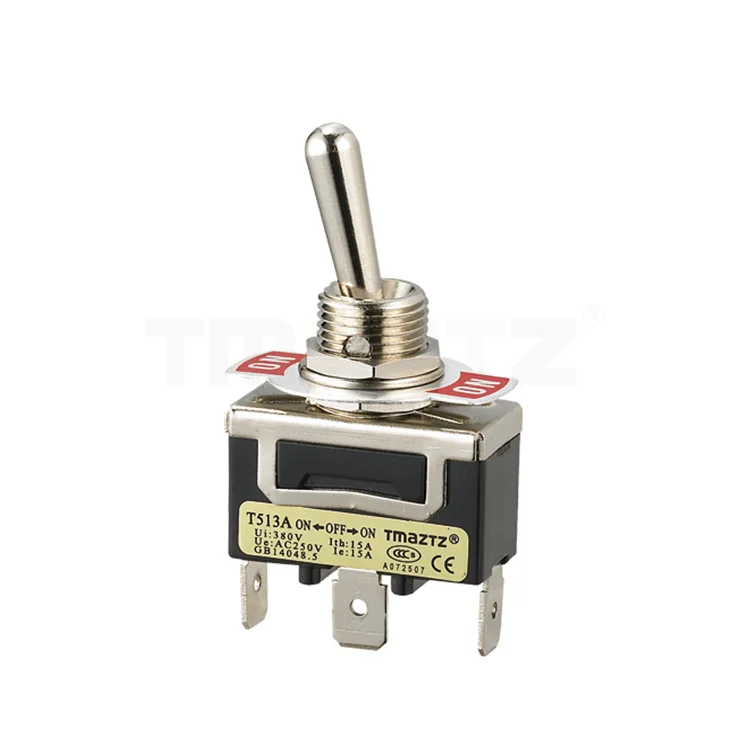
A panel toggle switch with maintained and spring-return actions, where single-throw and double-throw versions both return. Screw, solder and quick-connect terminals cover the wiring habits of different panel shops.
WHAT MAKES THE T5 SERIES
The movement comes in a fixed type and an auto-return type. Both single-throw and double-throw contacts can be ordered with spring return, so momentary circuits stay within one series.
An optional rubber cap seals the lever entry against water and oil. The cap fits every model in the series, so washdown panels use the same switch as dry ones.
The switch withstands 1890VAC for one minute between live parts. Contact resistance starts at 15mΩ and insulation resistance stays above 100MΩ at 500VDC.
Screw terminals suit field wiring, solder #187 tabs suit harness assembly, and quick #250 tabs suit high-volume panels. Every contact form accepts all three.
The code reads as type, contact form and terminal. TO and T5 set the rating, R marks spring return, and eight contact codes pair with three terminal letters.
Contacts are rated for more than 25,000 operations at full load. The lever mechanism works from -10°C to +70°C at humidity up to 85%RH.
Every model mounts through a φ12mm panel hole and weighs between 24.5g and 36.5g. See how the contact code system works in the selection table below.
WHERE T5 FITS
Machine control panels use T5 toggles for mode selection and auxiliary circuits. The 15A rating handles direct load switching on smaller machine functions.
Line control boxes mount rows of toggles for zone power and manual override. Quick-terminal versions speed up harness work when a box carries many circuits.
Control stations on hoists and small cranes use spring-return toggles for jog functions. The rainproof cap suits outdoor lifting gear exposed to weather.
QUICK MODEL SELECTION GUIDE
01
A single load that the operator turns on and off. Contact code 11 is the SPST ON-OFF form with two terminals.
02
One input routes to either of two outputs. Codes 12 and 13 are SPDT forms; code 13 adds a center-off position.
03
Two isolated loads switch together from one lever. Codes 21, 22 and 23 cover DPST and DPDT layouts with up to six terminals.
04
The circuit activates only while the operator holds the lever. An R suffix on any code gives the auto-return version.
DOCUMENTATION